The unconscious and the gaze: a scientific approach
Why does someone's gaze calm you or put you on alert before they even speak? Because your nervous system has already decided, below the threshold of awareness. The polyvagal theory of the American neuroscientist Stephen Porges (1994) gives a scientific basis to what hypnotists have always known.
Neuroception: the unconscious watching
Porges calls it neuroception: a continuous, automatic check the nervous system makes below awareness. Am I safe? Is there danger? To answer, it reads above all the face, the eyes, the tone of voice, the movements of the other person. The conscious mind comes later.
Three states
- Safety: we open
- When the unconscious feels safe, the gaze softens, the voice opens, we listen and let ourselves be guided. This is the door to the hypnotic state, focused and relaxed.
- Alert: we close
- Faced with danger, the body prepares to fight or flee, attention narrows, suggestion does not get through.
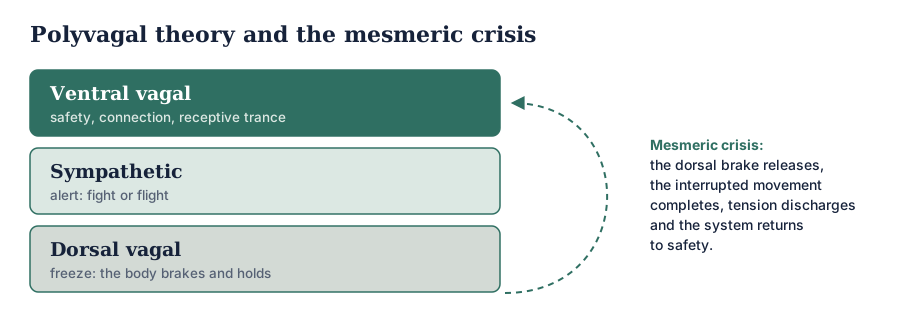
- Stillness: we freeze
- Faced with a strong, sudden stimulus, the nervous system may return to its oldest response: immobility, like the animal fixed by a predator's gaze.
What it explains about hypnosis
- A calm, steady gaze tells the unconscious "you are safe": the person relaxes and accepts being guided.
- A sudden, intense gaze triggers an orienting reaction, even a brief freeze: the rapid fascination Donato showed on stage.
- The skilled hypnotist alternates the two: first creating safety, then gathering attention into the gaze.
- When the brake of freeze is released, the body discharges through movement what had stayed blocked: this is the polyvagal mesmeric crisis.
The scientific link between animal hypnosis and human hypnosis
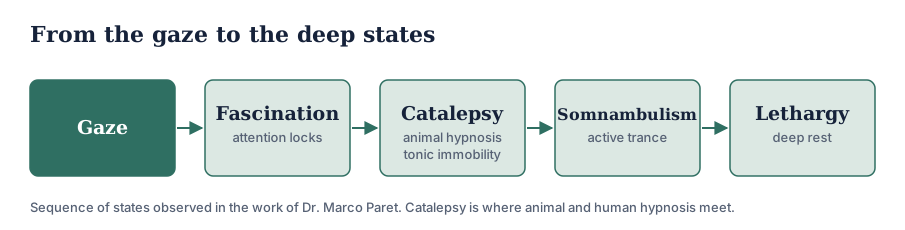
In 1646 the Jesuit Athanasius Kircher described the «experimentum mirabile»: a hen held still in front of a chalk line stays motionless, as if spellbound. In the nineteenth century William Preyer and later Ivan Pavlov studied this «animal hypnosis» as an immobility reflex; the Hungarian psychiatrist Ferenc Völgyesi, in his book on human and animal hypnosis, showed how close it is to human hypnosis.
Today biology calls it tonic immobility: an ancient response shared by animals and humans, driven by the brainstem and the dorsal branch of the vagus nerve. In Dr. Paret's work the gaze triggers the same sequence of states. Catalepsy is where animal hypnosis and human hypnosis meet.
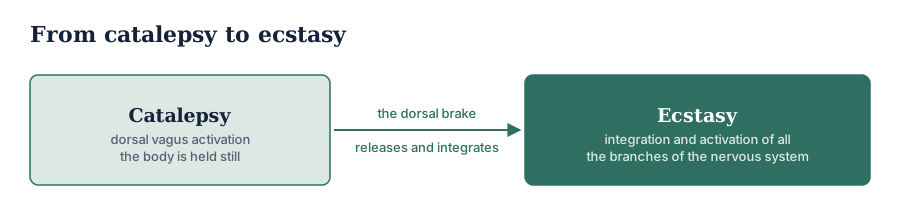
Yet human beings can go beyond the freeze. When the dorsal brake releases and all the branches of the nervous system integrate, catalepsy turns into ecstasy: the state the nineteenth-century magnetists described and that Mesmerismus® seeks.
Scientific publications
Dr. Paret's papers are available on Academia.edu: