The power of fascination
What happens in the brain
In his book Ipnosi Istantanea e Fascinazione (Instant Hypnosis and Fascination), Dr. Paret distinguishes the everyday attraction we all know from fascination proper: a state in which attention gathers entirely on one point and active attention to everything else falls away. He calls it “passive consciousness”: the person becomes powerfully influenced by the imagination and the will of the other.
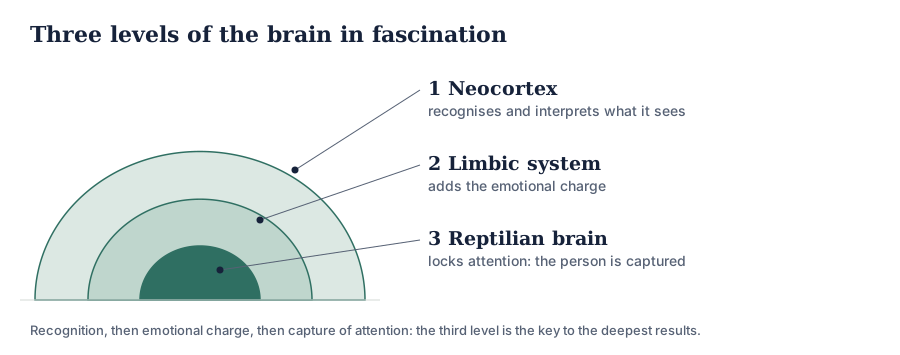
The process has three stages and involves three levels of the brain: the cortex recognises and interprets what it sees; the limbic system adds the emotional charge; the oldest, reptilian brain locks attention and captures the person. Much hypnosis research has stopped at the first two levels; the third, the deepest, is the key to the most remarkable results.
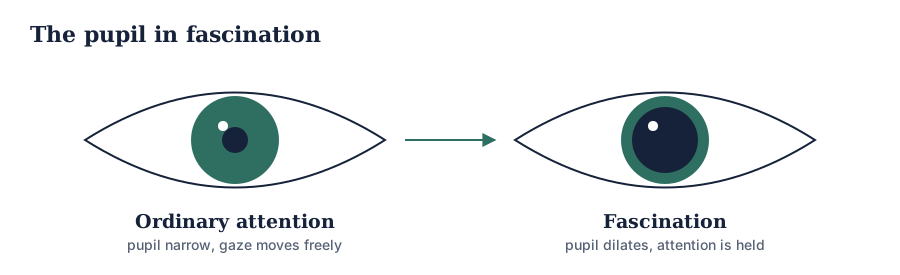
Fixing the gaze also changes the rhythm of brain waves (Hess, 1972), and when two gazes meet, the heartbeat changes too: by correlation, what happens in the fascinator is mirrored in the fascinated person. In the most intense forms the pupils dilate and the perception of the surroundings changes.
As you read these lines, your eyes move from one word to the next. Every day, without noticing, those same eyes decide whom you trust, who attracts you, who makes you uneasy. The gaze is the oldest and most direct channel to the unconscious. Whoever learns to use it can influence subtly, deeply, sometimes in a single instant.
Donato's discovery
At the end of the 19th century the Belgian fascinator Donato filled theatres across Europe. Dr. Paret's archive holds an article he wrote for the American magazine Cosmopolitan. Donato tells how his first discovery came from impatience: he wanted to finish quickly, his will passed into his gaze and gestures, and the subject fell into the state with surprising speed.
Professor Bernheim of the Nancy school describes the scene: the subject presses his hands hard onto Donato's; all his attention is there. Suddenly Donato fixes him from close up, then circles him without letting go with his eyes. The subject is captured: he follows with wide-open eyes and can no longer look away.
"No one can be fascinated or hypnotized against his will."Donato, article in Cosmopolitan
That is the secret of fascination: not force, but an attraction the unconscious agrees to.
Virgilio's notes
Dr. Paret continues the lineage of the hypnosis Master Virgilio T., the last to know the secrets of hypnotic fascination.
On Dr. Paret's copy of the article, the hypnotist Virgilio T. wrote his rules by hand: good subjects are sensitive and intelligent; be quick and give the conscious mind no time to "start thinking"; say little, briefly and firmly. It is the same insight as instant hypnosis: the conscious mind is slow, the unconscious is immediate.
The gaze among animals
Fascination comes from the Latin fascinare: to enchant, to fix with the eyes. The bird that meets the snake's gaze does not flee: it stays still, as if spellbound. In Le Magnétisme Donato writes that he fascinated birds, snakes, lizards, frogs and toads.
In 1907 William Walker Atkinson, in Mental Fascination, quotes the explorer David Livingstone, seized by a lion: he fell into a dream-like state, with no pain and no fear, yet fully conscious. Two distant sources, one phenomenon: an intense gaze touches a very ancient key in the nervous system.
Today neuroscience explains that key.
A power that can be learned
A fascinating gaze is not a gift reserved for a few. In Dr. Paret's courses you learn it: distance and timing, stillness and pauses, the match between gaze and breath, and how to make the other person feel safe while their attention gathers, more and more, in your eyes.