Mesmerism and the mesmeric crisis
In English, to mesmerize means to capture someone's attention completely, to fascinate. The word comes from Franz Anton Mesmer, the physician who, at the end of the 18th century in Vienna and Paris, produced the famous "crises": very strong reactions, sometimes movements, trembling, tears or laughter, after which many people felt better. What was in those crises? Today we can explain it, and we can use it to heal.
The mesmeric crisis on video
Mesmer's crises
Mesmer had many enemies. In 1784 a commission appointed by the French king declared that his "magnetic fluid" did not exist and attributed the effects to imagination. But no one accused him of failing to heal people. Something in those movements and reactions worked. And in every era since, we find people who keep working in this direction.
Animals know how to free themselves
In nature dangers are constant and possible traumas are countless. Yet animals have a natural way of not staying trapped in them. The American researcher Peter Levine observed that wild animals that have been immobilized, for example after being tranquillized to be captured or treated, discharge the accumulated tension with spontaneous trembling and movement as soon as they are free, and then return to normal life.
This movement reaction has been linked to the completion of motor patterns that were left blocked and to a natural discharge of all the tension that builds up in the moment of freeze. It is the method the organism has always used to free itself.
The polyvagal explanation
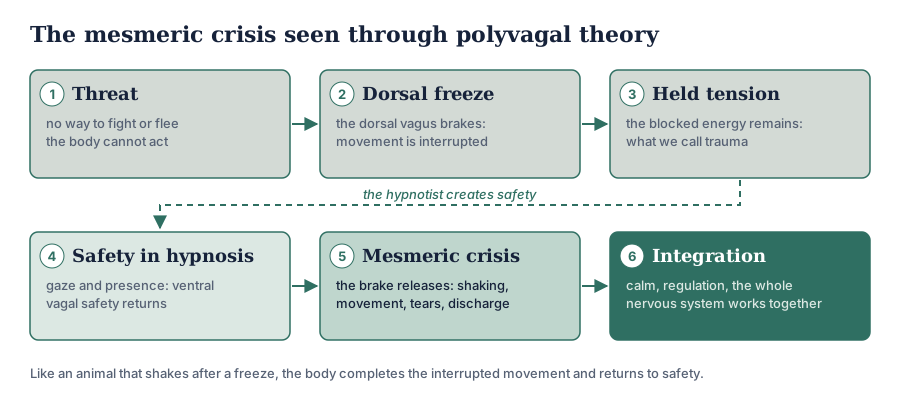
Polyvagal theory describes freeze as a brake: the dorsal branch of the vagus nerve stops the body when we can neither fight nor flee. If that block remains, what we call trauma is born. When the dorsal brake is released, the body can finally complete the interrupted movement and discharge the tension. That is why Dr. Paret speaks of the polyvagal mesmeric crisis: a deep, liberating release that now has a scientific explanation.
A thread through history
- Late 18th centuryMesmer produces crises with gestures, magnetic passes and touch.
- From 1784The Marquis de Puységur discovers "artificial somnambulism", a calm and deep state.
- 1843James Braid coins the word "hypnotism".
- From 1878Jean-Martin Charcot brings hypnotism into the Salpêtrière in Paris and gives it scientific standing. Movements and intense reactions appear in his demonstrations, but Charcot sets their therapeutic value aside: he is interested in the hypnotic phenomenon itself.
- 1895Sigmund Freud, with Josef Breuer, sees emotional discharge as liberating and calls it "abreaction". After him, therapy moves to words and, in parallel, to suggestion alone.
- 20th centuryAlongside, the body tradition continues: Wilhelm Reich, Alexander Lowen and others work with movement and the discharge of tension.
Hypnosis, in other words, was born containing the crises too: Charcot showed them. Dr. Paret brings back to the centre something that already existed.
What sets us apart: hypnosis with movement
Many work with movement, many with hypnosis. Dr. Paret's method joins the two: in the hypnotic state the person is left free to move, and free movement brings liberation. There is no need to tell the problem: sometimes talking about it would create a new trauma. Alongside the suggestive techniques, which guide with words and the gaze, there are liberating techniques, which let the body dissolve what has stayed blocked.
Traumas, accidents and life situations can block a person for years. The polyvagal mesmeric crisis is a deep technique of resolution: it helps people heal from trauma and brings them to be freer, fuller, and better. It is something new, and today's world needs it greatly.
Mesmerismus®
Mesmerismus® is Dr. Paret's registered trademark and his method: from the original sources he has reconstructed what truly works in mesmerism, magnetic passes and fascination, and joined it to the polyvagal mesmeric crisis.