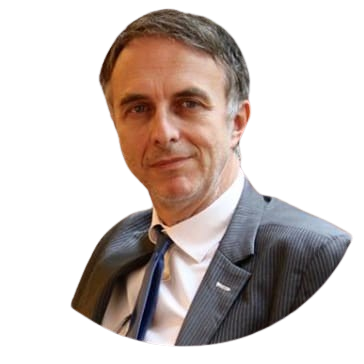
The so-called fluid and the hands: the sensory path of magnetism according to Prof. Dr. Paret
How many times have you felt a warmth or a tingling between your hands, appearing suddenly? Before proceeding, try a simple exercise right away: with the index finger of your right hand, point to the center of your left palm, the point called Laogong. Hold your finger very close, almost touching the skin. Do you feel anything? A warmth, a slight prickle, a pressure? Now move your finger away a few centimeters: does the sensation remain?
The so-called fluid, in daily practice, serves something very concrete: it improves the way we relate to others and to ourselves. In the family, for example, a touch or even just a hand approaching calmly can dissolve tension, as when soothing a restless child or a stressed partner. At work, the same gesture helps create a climate of trust before a negotiation or a difficult meeting. As Prof. Dr. Paret says, «touch can have a personal improvement effect»: full physical contact is not needed, because the nearby hand, without touching, allows the other to let go without defenses, achieving an even deeper result.
These abilities are not a gift reserved for a few: they are learned through a structured method, the one taught in the courses of the Université Européenne, the institute that organizes the school. Even alone, by practicing, results are seen right away; but a live course allows in a few days what would otherwise take years, because the harmony of the group breaks down barriers and energy is used for change. Afterwards, to maintain and refine what has been learned, just 10-15 minutes of daily exercise are enough. With constant application, anyone can achieve excellent and rapid results, feeling a real change in their own way of being.
This is the starting point of a path that Prof. Dr. Paret, founder of the ISI-CNV school, has been developing for over thirty years. A path that speaks of concrete and verifiable sensations, far from the language of mysterious energies. His approach is founded on a sensory and physiological basis, where the nervous system responds before words.
What is the so-called fluid
“You must absolutely not think you have to feel ‘a fluid’ in your hands,” warns Prof. Dr. Paret. “It is a concept to be seen physiologically. Focus on the sensation, which is physical: the sensation is there, it has a sensory basis, it can be explained neurologically. If we go beyond what we feel, we go into nothingness.”
Baron du Potet, a nineteenth-century magnetist, called it vital energy. “When you feel the energy — there is the vital energy. It depends on you, and everyone feels it: that pinch, that energy. Already feeling something is the beginning.”
Scientific prudence is the hallmark of this approach. Prof. Dr. Paret states clearly that the fluid exists as a subjective reality, before any measurement: “I never use the word fluid: I say ‘so-called fluid’, ‘some call it that’. If we say that the fluid exists from a subjective point of view, then it exists; and this does not mean having to measure it.” The honest openness remains: “I do not deny that one day something measurable may be discovered: but we start from what is there, and what is there can be felt.”
Starting from sensation
As Mesmer said, one must start from sensation. “People read books and do not understand, because they do not understand that they must feel; they think they have to measure something.” The point is to recognize what the body already communicates, before any theory.
When you feel a tingling, a warmth, a current between your hands, what is happening? It is physiology. “Science speaks of the parasympathetic system and connection,” explains Prof. Dr. Paret. “When you feel the tingling, you are feeling an activation of the parasympathetic: an activation of the connection system.” The parasympathetic is the branch of the nervous system that governs rest, digestion, and recovery. “And if we are in connection, we are in a space where science has shown there can be a healing disposition: the parasympathetic is central in regenerative processes.”
Contemporary research confirms: parasympathetic activation is associated with relaxation, recovery, and regeneration of the organism. Human touch and calm proximity measurably reduce stress and tension. Bodily sensations are the most direct gateway to deep states. This is why the Laogong exercise is an experience the body recognizes, and which can be repeated at any moment.
Hands at work: exercises and effects
From sensation to practice. A fundamental exercise, taught in seminars, is called “the ball”: “Place your hands in front of the solar plexus as if holding a ball. Imagine a ball you want to press but cannot: this gives energy to the solar plexus. Repeat the exercise.” The recommended variant is even simpler: point to the Laogong with your finger, very close, as you did at the beginning. “Easier to feel.”
The visible effects manifest quickly. “This area becomes very red, a strong reaction; the hands are clammy: it is a parasympathetic reaction.” Redness, warmth, local sweating are observable signs of a physiological response. “We must let the crisis flow: working on the solar plexus helps faster metabolization.” Bringing attention to a part of the body and feeling a sensation linked to blood: “we feel it when the parasympathetic is activated.”
The points of the body
The solar plexus, called Manipura in the Indian tradition, is a key. “Circular movements on the plexus rewire the nervous system,” states Prof. Dr. Paret. It is the center of will, self-esteem, and transformation. Working on it with hands at a distance allows one to “hypnotize without touching by stimulating the plexus.”
Another central point is the third eye, the area between the eyebrows. “Because it stimulates the pineal gland,” specifies Prof. Dr. Paret. The pineal, involved in regulating rhythms and producing melatonin, is a bridge between sensory stimulation and altered states of consciousness. Few know this: the stimulation of these points, with slow circular movements, is a practice that spans cultures and centuries, and here it is taught with anatomical precision and respect for tradition.
A documented tradition
The ISI-CNV school is rooted in a rich and documented history. Prof. Dr. Paret’s Library houses nineteenth-century treatises, rare texts, and clinical studies testifying to the magnetism of the hands. Here are some significant excerpts:
“La main ouverte, les doigts sont légèrement courbés, et leur pointe est un peu plus élevée que la paume de la main. Je fais les passes à une distance de deux à quatre pouces.”
— Nineteenth-century practical treatise on magnetism, historical collection of the Library
The hand open, fingers slightly curved, with the tips a little higher than the palm. I make the passes at a distance of two to four inches.
“D’autres sentent quelque légère douleur, une chaleur locale ou une chaleur universelle, et ont des sueurs.”
— Nineteenth-century study on Donato’s method, Donato collection of the Library
Others feel some slight pain, a local warmth or a general warmth, and experience sweating.
“L’azione del magnetismo non altro è che una sostituzione del proprio modo di vibrare il proprio fluido vitale nel fluido vitale dell’altro individuo, onde questi, sebbene conservi il proprio fluido, pure vive la mia vita.”
— Nineteenth-century Italian magnetizer, text from the historical collection of the Library
These texts are the foundation of a living lineage. Prof. Dr. Paret recounts that his master, Bacci, learned the techniques from Racanelli, a magnetist who “spoke of vital fluid” and who was “more than a hypnotist, a magnetist”. A direct line that reaches the seminars of today.
Beyond suggestion: animals
A surprising argument is the role of animals. “Animals also feel these things: it means it goes beyond suggestion, because animals cannot be swayed by words or expectations.” If a horse or a dog calms down with hands a few centimeters from the body, at a distance and without words, something real is happening. “There are also animal healers: many cases of animal healings are also reported in my books.”
This observation shifts the phenomenon from the plane of belief to that of biology. Non-verbal communication, warmth, presence: animals perceive it with a sensitivity that humans have forgotten, but which they can rediscover.
The system’s plus
What distinguishes the ISI-CNV school from widespread practices like pranotherapy or reiki? The system. “We have a dynamic system, much more complex: it contains many things and is very rich.” A complete path — much more than a single technique — integrating states, passes, gaze, presence, lineage, and the Library. A method that respects other paths and recognizes their value, but offers a rare depth.
The hands, in this context, have a dual role. “Certain gestures are linked to non-verbal communication: when we move our hands we also have a quasi-energetic communication, beyond the movement itself.” As explained in the article on hands in non-verbal communication, the gesture is a channel that transmits state, intention, and presence. To delve deeper into the theoretical basis, one can consult the encyclopedia entry Non-verbal Hypnosis.
Research continues
Prof. Dr. Paret’s work integrates tradition with contemporary research. His approach combines “everything together”: Taoist Neidan, Western magnetic Alchemy, and the systematic comparison between Eastern and Western traditions, through the CAIRN project. An endeavor seeking points of contact between different paths, maintaining the precision of each.
For those who wish to approach, the magnetic passes are a concrete first step. And to understand the historical roots, the page on Mesmerismus offers an in-depth overview.
Frequently asked questions
Do I have to believe in something for it to work? No. “You don’t have to believe it: you practice it and you feel it.” Experience precedes belief.
How long does it take to notice results? Often very little. Verifiable signs — warmth, tingling, relaxation — often appear from the first exercises. Depth grows with practice.
Is it a form of hypnosis? It is a complementary path. It integrates with verbal hypnosis, as explained in the encyclopedia entry. “Some things are done with words; for others, you can go deeper, or get there equally, without using words. Knowing both paths makes the operator complete.”
Are there any contraindications? The practices are gentle and non-invasive. However, as with any work on the body and mind, it is important to consult qualified teachers and not replace medical care. The ISI-CNV school provides a preliminary interview to assess suitability and motivation.
Who can learn? Anyone interested in a serious and verifiable path. “For serious researchers: entry to the courses involves a brief interview.”
The so-called fluid is an experience to be had, more than a substance to be measured. The hands are its instrument, the body the laboratory, the sensation the proof. No formula to learn: the process is natural and passes beneath words.
